
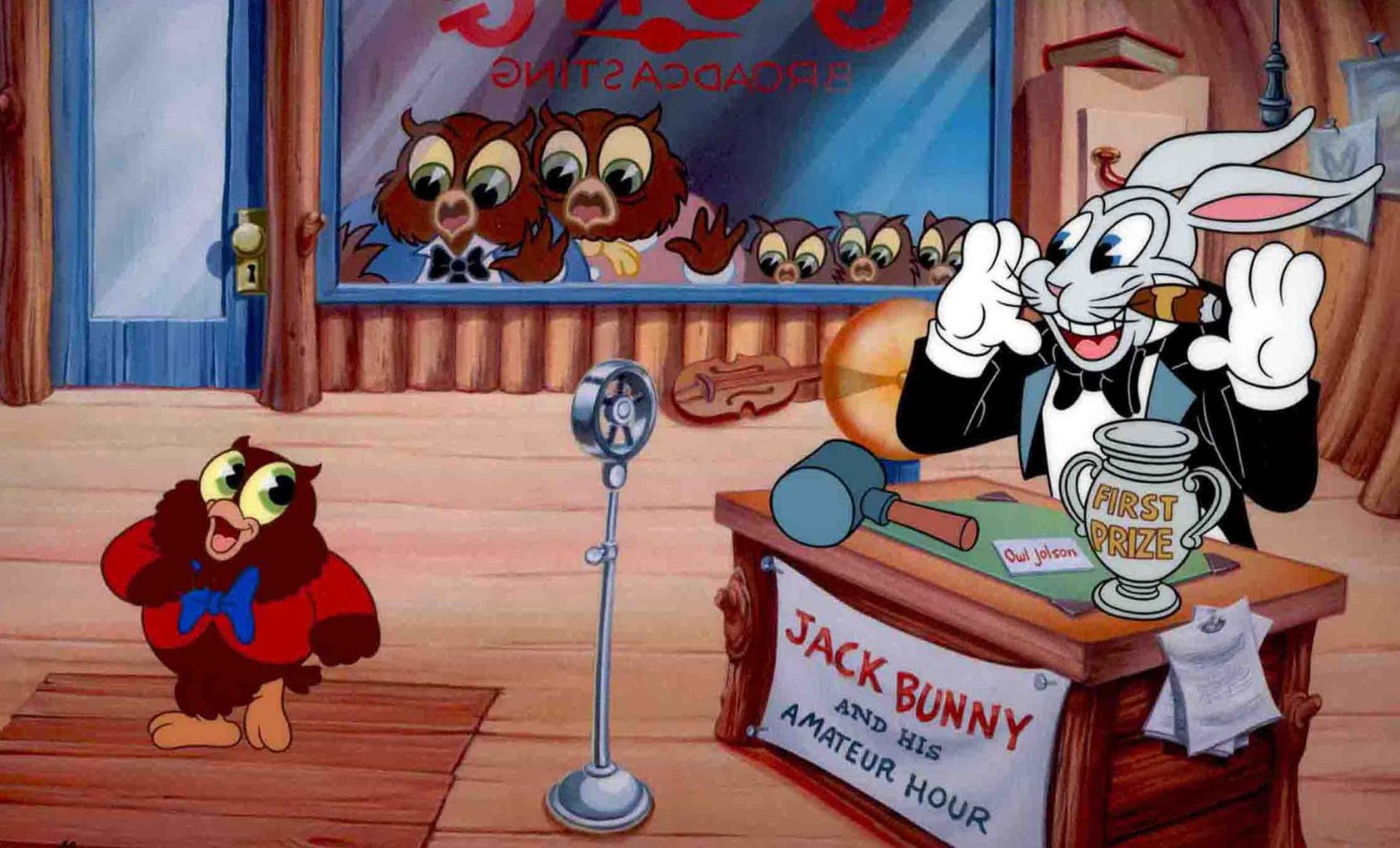
87 years ago today (July 18, 1936), “Owl Jolson” made his grand debut on the big screen and sang his way into the hearts of American moviegoers. Several decades later, “I Love To Singa” would become one of my most memorable cartoons and maybe one of my earliest connections to jazz music.
The story of “I Love To Singa” begins with a musical owl couple, Professor Fritz Owl and his accompanist wife, who are eagerly awaiting the hatching of their four eggs. Outside their home, a sign reads that Fritz Owl is a “teacher of ‘voice, piano & violin’ BUT- NO JAZZ!” Naturally, they have high hopes that their hatchlings will follow in their same love for classical music.

The first hatchling emerges and immediately belts a few lines from “Chi mi frena in tal momento” from Lucia di Lammermoor by Gaetano Donizetti. The second egg pops open with an owl already holding a violin in their hands. They play a segment of “Träumerei” by Robert Schumann. A third egg springs to life, and an owl with a flute begins “Spring Song” from Felix Mendelssohn’s Songs Without Words. The owl parents are very pleased so far.
At long last, the final egg cracks open. “Hello, Stranger!” the owl bellows with a wave to his new folks. He immediately dives into a swinging chorus of “I Love To Singa” while strutting to and fro along with the rhythm.
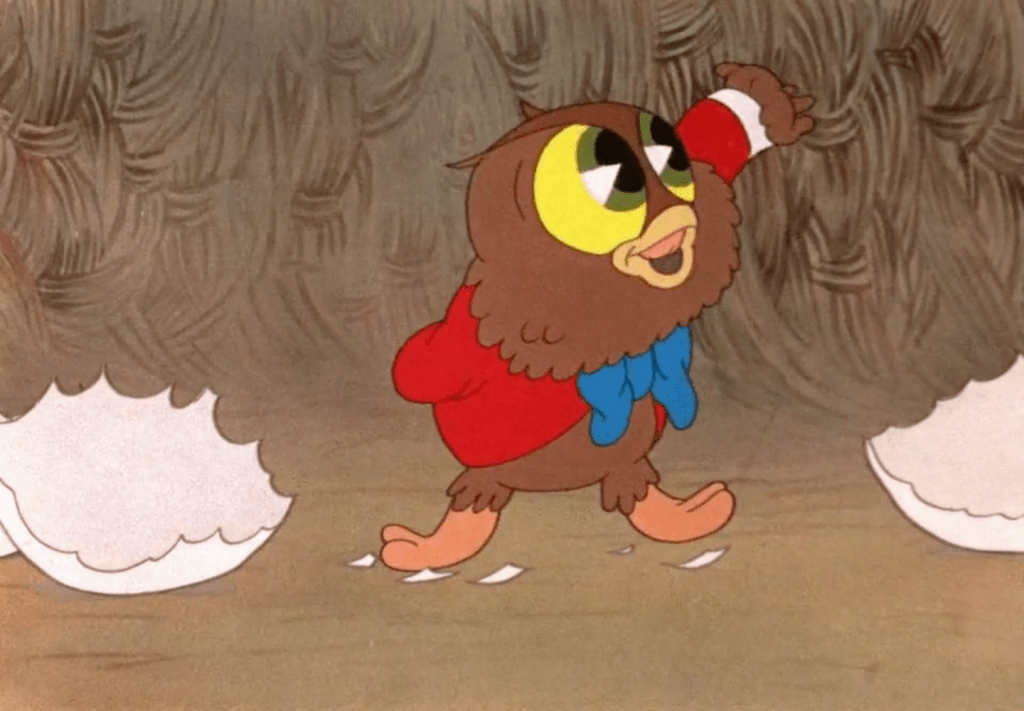
“Ock!!! A jazz singer! A crooner! Stop. Stop! STOP!” his father shouts in horror. Mrs. Owl passes out. This is unacceptable! Professor Fritz, feverishly fanning his wife, assures her that “if he must sing, we will teach him to sing like we want him to.”
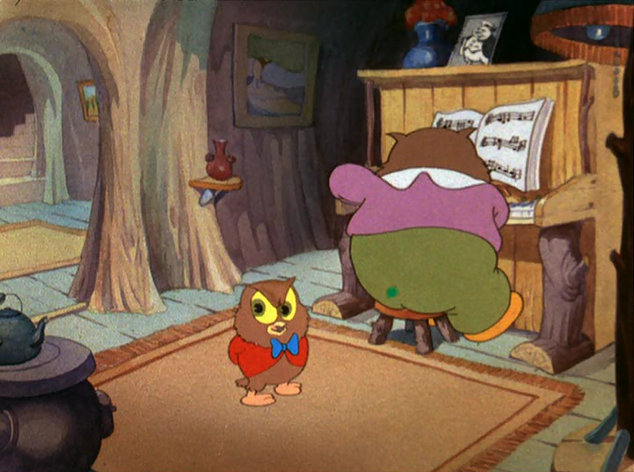
The next scene depicts a very annoyed youngster who quietly sneaks in bits and pieces of his jazz tune between lines of “Drink To Me Only With Thine Eyes” while Mama owl turns pages. When he’s able to fit it in, his eyes light up, and he bobs along with the music. When singing his art song, his stance is rigid, breath support is gone, and his tone has an edge of nasality. He hates it. The father eventually catches him and, in a fit of rage, promptly throws him out of the house.
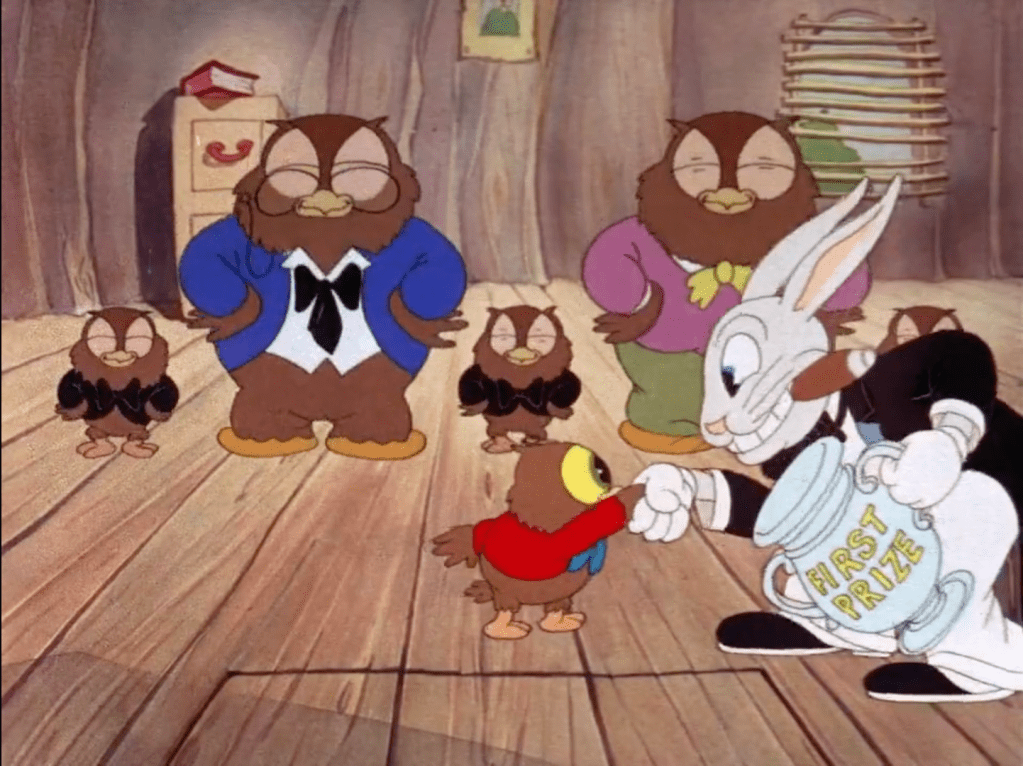
Our young crooner seems unaffected by this whole scenario and merrily makes his way down the street, continuing to sing his favorite song. He stumbles upon a talent contest at a nearby radio station and eagerly jumps in the line. With a shot at finally showcasing the music he loves, he hands the judge a business card that reads “Owl Jolson” and starts to perform. The judge, who had quickly dismissed the last several lackluster acts, is enthralled with the young owl’s energy. He reaches for the First Prize trophy.
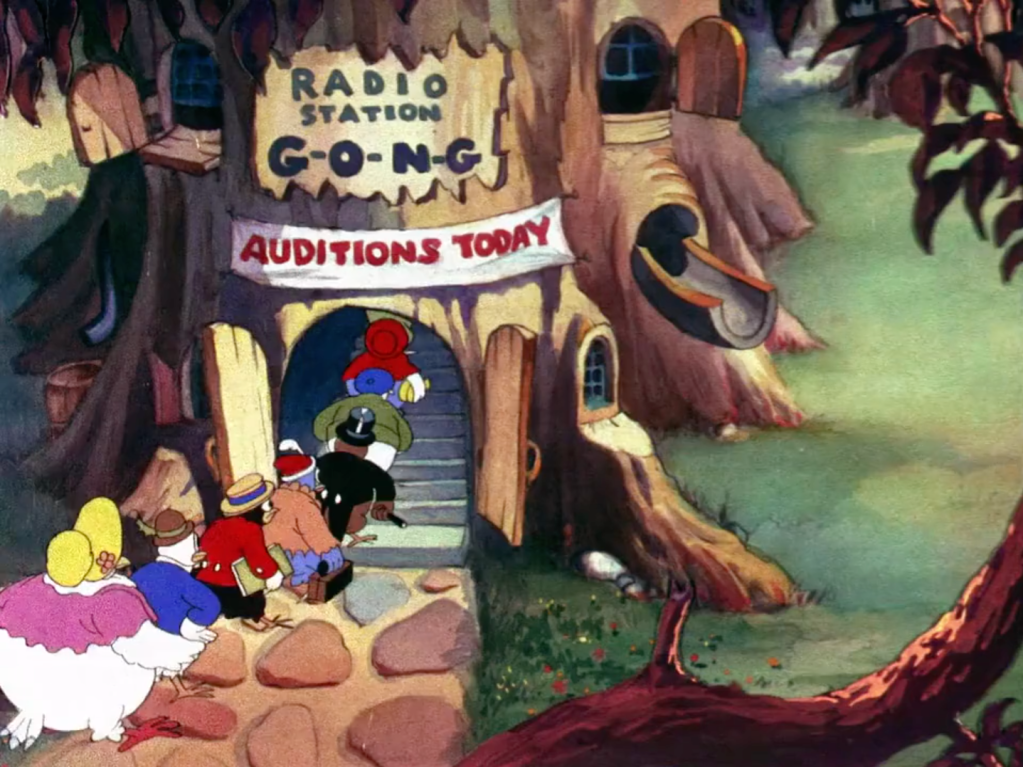
Meanwhile, the Owl family, who has since put out a call for their missing son (even though they were the ones who threw him out) hears their son’s voice on the radio and rushes to the station. When Owl Jolson notices them watching through the window, he trauma reacts to their appearance and begins to sing his old classical repertoire. The judge begins to put the trophy back. Professor Fritz sees what’s happening and hurries inside.
“Stop! Stop! Stop! Enough. It’s too much!” he says as he takes the boy into his arms. Realizing that his son truly does have talent and others are noticing, he begins to sing the same song that he hated so much before (with a few changes to the words). “Go on and sing-a, about your moon-a and your June-a, ’bout-a Spring-a.” He raises his finger in the air, smiling, and starts to dance. “Go on and sing-a!” The young owl catches on and finishes the lyric. The rest of the family fall in line behind him and act as backup dancers while the performance carries on. Pleased once again, the judge excitedly shakes the hand of Owl Jolson and awards him the aforementioned First Prize trophy. Jazz wins!
I didn’t know it at the time, but this entire short is a tribute to The Jazz Singer, a 1927 film starring Al Jolson. Its release was significant in that it was the first picture to break free from the silent film era and feature audible dialogue/singing along with background music. This movie also carries with it some historical controversy as its story involves the main character performing in blackface to try to earn their fame.
The song “I Love To Singa” was from Al Jolson’s 1936 film The Singing Kid and can be heard in one of the first scenes where Jolson’s character sings atop a rooftop along with Cab Calloway who is standing on an another nearby ledge. It was common then for Warner Bros, who owned the rights to these films and songs, to ask for cartoons to feature their music in order to promote sales of songs.
As a music teacher and a lifelong music student, I can relate to a lot of the themes in the “I Love To Singa” cartoon. I, too, would often shun the “boring” music that my teachers gave me and seek out opportunities to learn the “fun” songs for which I actually cared. Now that I’m in education, it’s a tricky balance to select repertoire that students will enjoy while also employing fundamental techniques. Furthermore, I am somewhat bound by the curricular requirements that are set in place by my institution.
Despite this, the last thing I would ever want to do is turn my students off to music simply because I didn’t have a natural affinity for their musical tastes. As an arranger, I’ve been fortunate to find something of value in almost every piece of music to which I’ve ever been exposed. I try to help my students find that kind of connection. It doesn’t always work. But, at its core, I think music is about exploring, experimenting, and just having fun.
Check out the full 1936 “I Love To Singa” cartoon below:
Thanks for stopping by to check out my writing! Do you remember this cartoon or some other musical shorts from this time? What were some of your favorites? Leave me a reply and let me know! Also, if you enjoy my content, consider following my blog or subscribing via e-mail to have posts delivered directly to your inbox.
Help me out by sharing my content with your friends, and visit my Linktree to see more of my stuff!
Sources:
https://en.wikipedia.org/wiki/I_Love_to_Singa
https://en.wikipedia.org/wiki/Merrie_Melodies
https://moviechat.org/tt0027779/I-Love-to-Singa/58c701804e1cf308b932b42e/Owl-Jolsons-first-words
Bonus: Anyone remember when “I Love To Singa” was featured on the first episode of South Park?
 Eric Hagmann Music
Beautifully said. What an interesting story and fun little cartoon. Thank you for sharing ❤️
LikeLike
Excellent post! Love your description of the cartoon and especially your personal connection to and identification with it as a student and teacher of music.
Also, you simply can’t beat the animation style used in the 1930’s and 1940’s.
LikeLiked by 1 person
Thanks!! It says a lot about the staying power of these shorts to remain so deeply imbedded in my memory after all this time. Maybe there should be a resurgence of new cartoons that are meant to promote the songs of today! Would it work? Actually, that’s kind of what tiktok does 😂
LikeLiked by 1 person
I didn’t know about the movie, and so, thank you for mentioning it. I’ll have to watch it now. It seems to have a fantastic plot. Yes, music is about experimenting and having fun and adding your identity and spin on the songs you create or play. A really interesting post btw.
LikeLiked by 1 person
Thank you so much for reading! I learned a lot from my research on this cartoon, so I’m glad I dug into it! And I totally agree about your take on music.
LikeLiked by 1 person